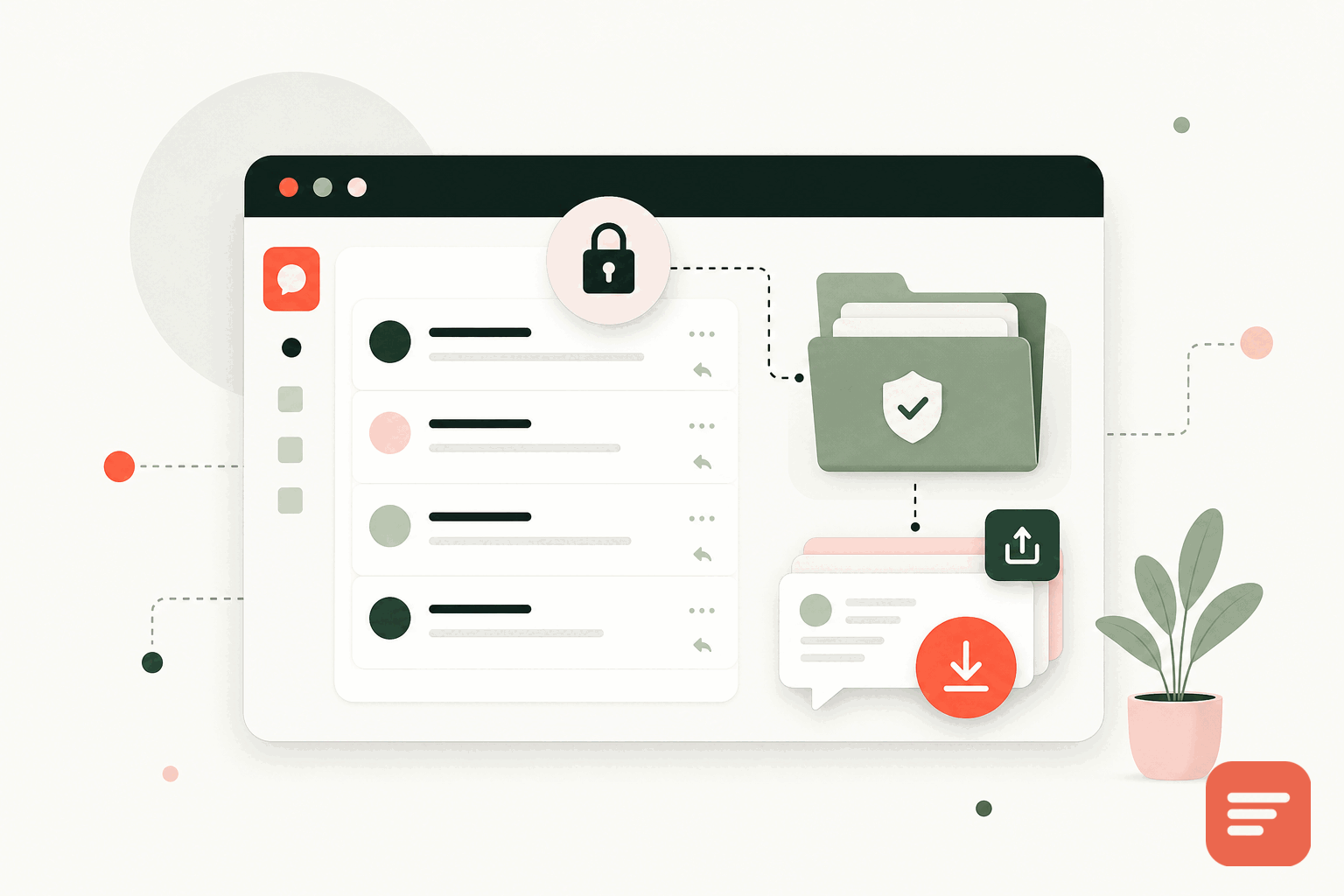
Comments are content. Your readers write them on your site, under your articles, in response to your work. Yet with many comment tools you do not really hold that content. It lives on a vendor's servers in a format you cannot easily get out, and if you ever want to leave, the comments are the hostage. Owning your comment data means you can read it, export it, and move it whenever you choose. That is not a luxury feature; it is the difference between renting your discussions and keeping them.
Why ownership matters
Three situations make the point concrete:
- You want to switch tools. If you cannot export, changing comment systems means losing years of discussion, along with the SEO value attached to those pages.
- A reader asks to see or delete their data. Under privacy law you may have to comply, and you can only do that if you can actually get at the records.
- The vendor changes. Prices rise, terms shift, or the service shuts down. If your data is locked in, you are stuck with whatever happens next.
If you cannot export your comments, you do not own them. You are borrowing them from whoever controls the export button.
What real ownership looks like
Ownership is not a slogan; it is a set of concrete capabilities. You should be able to:
- Export all your comment data on demand, without asking support.
- Get it in a standard, usable format rather than a proprietary blob.
- Use that export to move to another system or to answer a data request.
- Trust that nobody is quietly monetising the data behind your back.
That last point matters. Some free comment tools pay for themselves by tracking your readers and selling access to that behaviour. In that model your comment data is not just locked in, it is being used against your readers' interests. Ownership is weaker when the vendor's business depends on the data staying with them.
How Gabden supports it
Gabden treats your data as yours. You can export it as JSON or CSV whenever you want. JSON keeps the full structure for moving into another system; CSV is easy to open in a spreadsheet for a quick look or to hand to someone answering a data request. There is no support ticket and no waiting; the export is a feature you control.
The privacy model reinforces this. There are no tracking cookies, no fingerprinting, and no cross-site tracking, and analytics are anonymous and aggregate. Gabden is not building a behavioural profile of your readers to monetise, so the data you export is the data that exists. You are not competing with the vendor's incentives to hold onto it.
Portability in both directions
Ownership works both ways. Just as you can export, Gabden can import existing comments from Disqus, native WordPress, and other systems, mapped to each page's URL. Because every thread is keyed to the page's canonical URL, comments stay attached to the right pages whether you are moving in or moving out. You are never trapped by the format, which is what portability is supposed to mean.
A quick test for any comment tool
Before you commit, ask the vendor three questions:
- Can I export all my comments myself, right now, without contacting support?
- What format do I get, and can another system read it?
- Does the tool make money from tracking my readers?
If the answers are no, a proprietary format, and yes, you do not fully own your data. If they are yes, JSON or CSV, and no, you do. The broader privacy picture is covered in a guide to privacy-focused blog comments. To keep your discussions portable from the start, register a free site, or read more on the conversations page.
Join the discussion