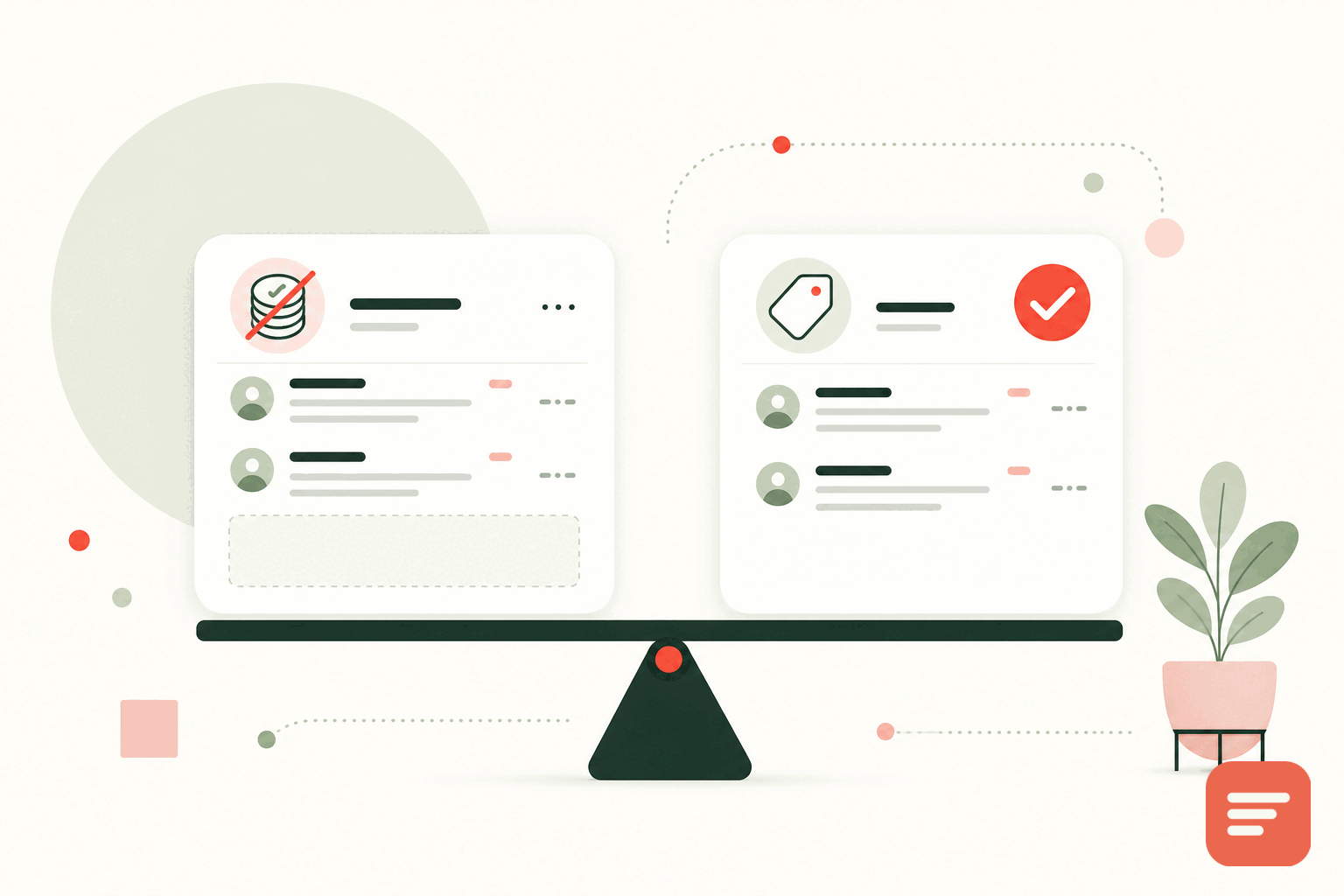
"Free" is the most expensive word in software pricing, because it usually means the cost is hidden rather than absent. Comment systems are a clear example. A free comment widget is running a business somewhere, and if you are not paying, the payment is coming from somewhere else. This is an honest look at what free comment systems cost, and when paying a few dollars a site is the cheaper choice.
How free comment systems pay for themselves
A comment system needs servers, storage, spam handling, and engineers. Those cost money. If the product is free to you, that money comes from one of a few places:
- Advertising: the widget shows ads in or around your comments, and the vendor keeps the revenue. Your readers see ads on your site that you did not choose.
- Data: the widget tracks your readers and their behavior feeds an advertising business. Your visitors are the product being sold.
- A limited free tier: the honest version, where free covers small sites and paying covers larger ones, with no ads or data harvesting in between.
The first two are the expensive kind of free. The third is genuinely free at your scale, and the difference between them is worth understanding before you install anything.
The hidden costs of ad-supported free
When a free comment system pays itself with ads and tracking, you pay in ways that never appear on an invoice.
An ad-supported comment widget turns your comment section into someone else's billboard, on your page, against your readers.
- Speed: ad and tracking scripts are heavy. They add network requests and main-thread work, slowing the pages you worked to make fast, which also drags on your Core Web Vitals and rankings.
- Trust: readers notice ads and trackers, and a comment section that feels like a monetization surface undercuts the credibility comments are supposed to build.
- Privacy risk: tracking your readers through a third party can create data-rule obligations you did not sign up for and cannot fully see.
- Control: the ads shown are the vendor's choice, not yours, and can sit right next to your content.
When paid is the cheaper option
A paid comment system at a few dollars a month looks more expensive on paper and is often cheaper in reality. You are paying to remove the ads, the tracking, and the speed penalty, which is buying back trust, page performance, and control. For a site where those things translate into readers or customers, that trade pays for itself quickly.
The math is simple. If a free widget slows your pages enough to cost you rankings, or its ads cost you a fraction of your credibility, a flat few dollars a month is trivial against that. Paid is not about getting more features. It is about not paying the hidden costs.
A fair free tier looks different
Not all free is a trap. A fair free tier is transparent: it covers small sites with no ads and no tracking, and it asks you to pay only when you outgrow it. The tell is what happens to your readers. If the free tier still respects their privacy and keeps the page light, the vendor is using free as an on-ramp, not as a cover for an ad business.
How Gabden prices it
Gabden is the fair-free-tier model, made explicit. It is free forever up to 100,000 widget views a month per website, and that free tier has no ads and no tracking. The only visible cost is a small "Powered by Gabden" mark. There is no advertising in your comments and no reader data being sold, on any tier. When you outgrow the free views, or want the mark gone, Plus is five dollars a month per website for unlimited views. Billing is per website and you can cancel anytime.
Because the business model is a straightforward subscription rather than ads or data, the incentives line up with yours: keep the widget light, around ten kilobytes, keep readers' data untouched, and let you export everything as JSON or CSV whenever you want. That is the version of free worth choosing, and the paid step is small and predictable.
If you are weighing this for a small site specifically, the small business guide covers the same ground from that angle, and the full pricing lays out both tiers. When you want to see how far the free tier gets you, create a site and watch your view count in the dashboard.
Join the discussion